
Contents
- Start with eligibility, consent, and privacy—not output quality
- Prepare one controlled brief before spending credits
- Calculate free-tier value by usable attempts
- Run a matched evaluation session
- The final ClothOff decision checklist Updated October 12, 2026
ClothOff is best understood as a decision guide, not an AI video generator. Its published description says the site independently compares adult AI image and video services using five criteria: input rules, sustainable motion quality, cost per kept clip, deletion and retention, and product-change velocity. That distinction matters. You can use ClothOff to narrow the field, but generation, uploads, billing, and storage take place on whichever external service you ultimately choose.
During an editorial review on October 12, 2026, I opened the live homepage, sitemap, and published guides. The most useful finding was structural: the site consistently directs readers away from promotional galleries and toward questions that affect an actual generation session. It also provides no upload form, account area, or generation interface. That boundary should remain clear when evaluating any “ClothOff AI video” search result.
The following checklist turns that editorial framework into a practical process for comparing an AI Adults 18+ video generator without relying on a provider’s best-looking sample.
Start with eligibility, consent, and privacy—not output quality
Before comparing motion or image fidelity, establish whether a service accepts your intended input. Common models include self-images only, images of consented adult subjects, and text-only briefs. ClothOff’s consent comparison identifies self-image-only as the strictest common model: the uploader must be the depicted person.
This is a pass-or-fail check. A visually impressive service is irrelevant if its rules prohibit your source material. Confirm all of the following in the provider’s current documentation and interface:
- Every depicted person is an adult and has affirmatively agreed to the use.
- You have the right to upload the source image.
- The service permits that kind of input rather than merely accepting the file technically.
- The consent confirmation is visible before generation, not buried in general terms.
- The service has controls addressing impersonation and unwanted likeness use.
Next, inspect what happens after upload. Look for a stated retention period, manual deletion controls, account-deletion instructions, and an explanation of whether generated clips can appear publicly by default. “Delete” should also be defined carefully: removal from a gallery does not necessarily mean immediate deletion from active storage, backups, or moderation records.
Do not confuse ClothOff’s privacy position with that of an external generator. As of the October 12, 2026 review, ClothOff described itself as a static editorial site with no accounts, payment flow, or file-upload endpoint. Its privacy page states that it cannot receive a visitor’s photo, video, or prompt. Once you follow a link to another service, that service’s privacy and retention terms govern the upload.
Prepare one controlled brief before spending credits
A fair comparison needs the same task across every candidate. Choose one authorized, technically clean source image and define a modest motion brief. Starting with an ambitious sequence makes it difficult to tell whether a failure came from the model, the input, or conflicting instructions.
For image-to-video, separate what the image controls from what the prompt controls. The source establishes composition, appearance, lighting, and much of the subject detail; the prompt should primarily describe motion, camera behavior, and timing. Runway’s current image-to-video prompting guidance similarly warns that defects in a source image can become more noticeable once it is animated.
A useful first brief might specify one restrained subject movement, a stationary or slow camera, a short duration, and the intended aspect ratio. Record the exact prompt and settings. Then check whether the interface offers meaningful control over:
| Control | What to verify | Warning sign |
|---|---|---|
| Subject motion | Direction, intensity, pose, and timing | Only broad preset labels |
| Camera motion | Static, pan, tilt, zoom, or orbit | Camera moves despite a locked instruction |
| Composition | Aspect ratio and framing preservation | Cropping changes important details |
| Repeatability | Seed, reference reuse, or variation tools | Every retry starts from an opaque state |
| Constraints | Negative instructions or exclusion controls | No way to suppress recurring defects |
| Export | Duration, resolution, watermark, and format | Preview quality differs materially from export |
Review the whole clip, not a flattering still frame. Check identity stability, anatomy, background movement, temporal consistency, prompt adherence, and whether the final second deteriorates. A clip can look convincing at the start yet become unusable after a turn, camera move, or partial occlusion.
When an output fails, change one variable at a time. If the face and framing are stable but movement is excessive, reduce motion before replacing the source. If the model repeatedly misreads the composition, inspect resolution, aspect ratio, and file format. Current first-party troubleshooting from Runway lists overly low or high resolution, prompt-reference conflicts, unsupported formats, and unsupported aspect ratios among possible input problems. That is a useful diagnostic pattern, although another provider may impose different limits.
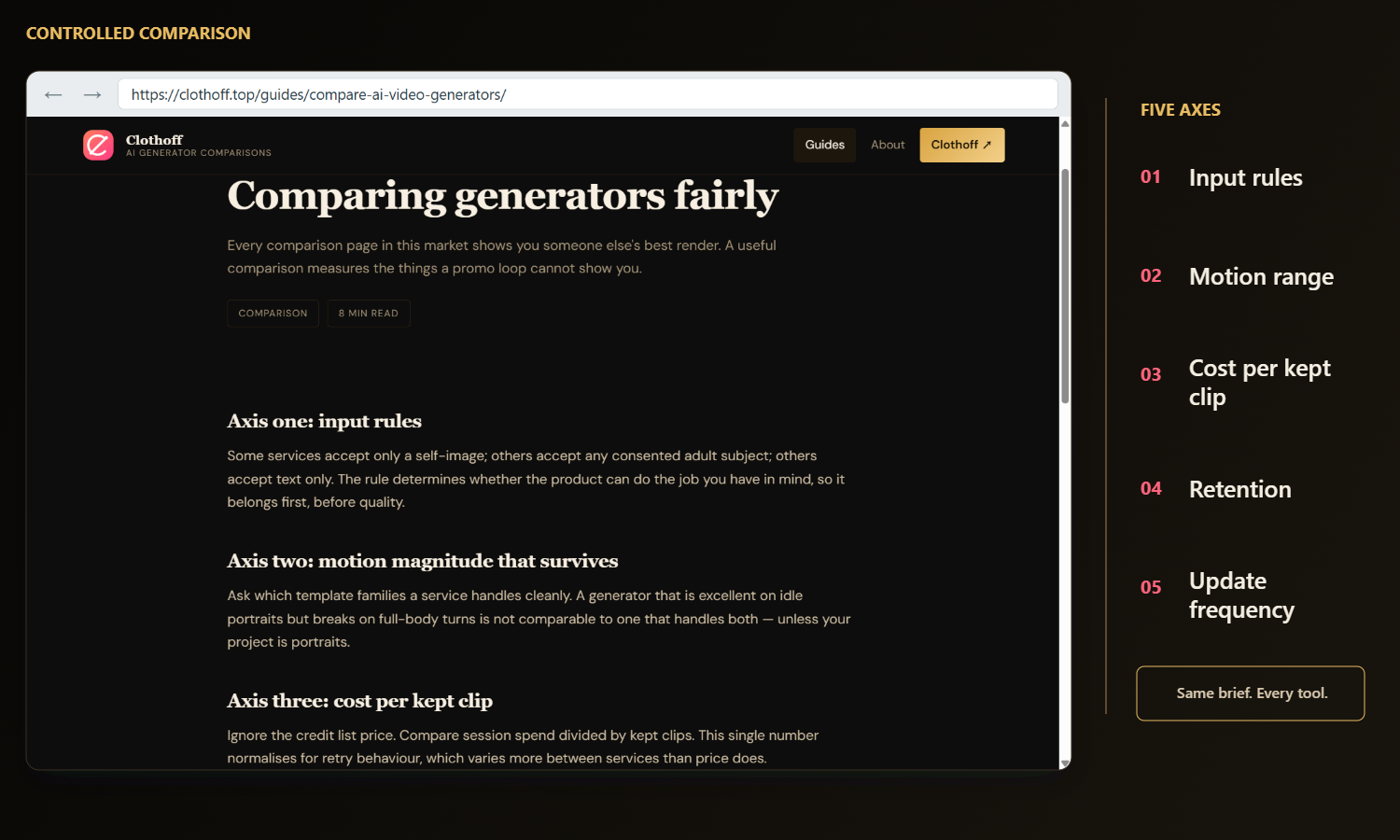
Use the same brief for every candidate, then compare results across five consistent evaluation axes.
Calculate free-tier value by usable attempts
A free tier is useful for checking whether a model reads your input correctly, but it may not represent paid output. Verify limits on duration, resolution, watermarking, model access, queue priority, downloads, and commercial use. Also determine whether the allowance renews or is a one-time grant.
A concrete market example shows why the distinction matters. According to Runway’s credit documentation, checked October 12, 2026, its Free plan included a one-time allocation of 125 credits, while Gen-4.5 cost 12 credits per generated second. At that documented rate, five seconds cost 60 credits and ten seconds cost 120. These figures apply to Runway’s documented plans and model at that time; they are not ClothOff pricing and should not be transferred to another service.
The better comparison metric is:
session credits spent ÷ clips worth keeping = credit cost per kept clip
Suppose five matched attempts cost 60 credits each. If only one is usable, the practical cost is 300 credits per kept clip—not 60. Keep-or-reject decisions should use the same standard across services, and near-duplicates should not be counted as several successes.
Retry rules can change that calculation sharply. Runway’s current refund explanation says a true generation error can trigger a credit return, while a completed result still consumes credits even when it misses the prompt, fails to preserve likeness, or is otherwise unsatisfactory. This is one verified example of why buyers must distinguish system failures from completed-but-unusable generations; it is not evidence that every provider follows the same policy.
Before purchasing, capture the credit balance before and after each attempt, generation duration, model, resolution, error message, and rejection reason. Screenshots are helpful because balances and plan descriptions can change.
Run a matched evaluation session
The smallest useful session is not one lucky generation. Use several matched attempts with the same source, prompt objective, duration, aspect ratio, and output tier. The aim is to estimate repeatability, not to produce a universal benchmark.
Score each attempt as kept or rejected, then attach a specific reason: identity drift, unstable anatomy, unwanted camera motion, background deformation, weak prompt adherence, moderation block, technical error, or export restriction. This produces evidence you can act on.
Use this sequence:
- Verify input eligibility and current consent requirements.
- Read upload retention and deletion terms before submitting media.
- Record the free allowance and every restriction attached to it.
- Generate one low-complexity motion test.
- Adjust only one variable after a failure.
- Repeat the matched test enough times to expose inconsistency.
- Calculate cost per kept clip, including paid retries and optional upscaling.
- Recheck export quality and deletion controls before committing to a plan.
The October 2026 sitemap review showed that ClothOff already groups its material around comparison, credit, and consent decisions. Its guide index is therefore the practical next stop for deeper checks—not an on-site generation dashboard.
The final ClothOff decision checklist
A suitable service should pass four gates. First, its input rules must clearly permit your authorized use. Second, its controls must cover the motion and framing your project actually needs. Third, its credit system must remain acceptable after realistic retries, not merely on the advertised price of one generation. Fourth, its retention and deletion terms must be specific enough for the sensitivity of the uploaded material.
Pause the purchase if you cannot determine whether completed rejects consume credits, what the free tier omits, how uploaded media is deleted, or whether your input category is permitted. Those are not minor details; they determine whether an apparently inexpensive generator is usable at all.
ClothOff’s strongest role is helping readers ask these questions in the right order. Treat its pages as an editorial filter, verify changing product details with the destination provider, and judge an AI Adults 18+ video generator by repeatable kept clips rather than its showcase reel.