
Contents
- Gate 1: Establish ownership and permitted use
- Gate 2: Record specific, informed adult consent
- Gate 3: Identify the actual service receiving the upload
- Gate 4: Resolve retention before submission
- Gate 5: Prepare a minimal local copy
- Gate 6: Test account and deletion controls on paper
- A documented ClothOff planning case
- The final go/no-go record
Updated October 13, 2026 · ClothOff Editorial Team
Before giving any Adults 18+ AI video generator a source file, set a simple threshold: do not upload unless you can identify the destination service, prove that you may use the file, document the informed consent of every recognizable adult, and explain what happens to the file after submission.
That distinction matters when researching ClothOff. As verified on October 13, 2026, clothoff.top describes itself as a static editorial site, not a generator: it states that it has no login, account system, payment flow, form, or file-upload endpoint. Its terms likewise distinguish the publication from generator operators. An outbound button may take you to another service, but ClothOff’s privacy information does not automatically govern that destination.
Treat every handoff to another domain as a new privacy decision. Check the final URL and audit the operator shown there before selecting a file.
Gate 1: Establish ownership and permitted use
Start with provenance, not image quality. You need to know who created the source and whether your rights cover AI transformation—not merely possession of a downloaded copy.
A usable source normally falls into one of these categories:
- You created it and hold the relevant rights.
- The creator gave you written permission covering the planned transformation.
- A licence expressly permits modification and the intended private or published use.
- The identifiable adult depicted separately agreed to the proposed processing.
Copyright permission and subject consent are different records. A photographer can license an image without having authority to approve a new depiction of the person in it. Conversely, the subject’s approval does not necessarily give you the photographer’s adaptation rights.
Retain the original licence, creator correspondence, source URL, acquisition date, and consent record. Screenshots can help preserve changing web terms, but they should supplement rather than replace the underlying agreement.
Stop if the file came from social media, a private conversation, a dating profile, an unknown repost, or a search result and you cannot establish both provenance and permission. Public visibility is not permission to transform a person’s likeness.
Gate 2: Record specific, informed adult consent
For a recognizable person, “they said I could use the photo” is too vague. The record should identify the adult, the file or session covered, and the agreed operation. It should also define whether outputs remain private, may be shared with named people, or may be published.
At minimum, confirm:
- The person is an adult under the rules applicable to the intended use.
- They understand that an AI system will process their image or video.
- The agreed transformation category and audience are stated plainly.
- Storage by the selected service has been discussed.
- Permission to create an output is separated from permission to distribute it.
- Any withdrawal expectations are recorded, including the practical limit that already-shared copies may not be recoverable.
Collect only the identity information needed for a reliable record, and store it separately from the media submitted to a generator. Do not place identity documents in the upload folder or combine them with the source file unless a verified service procedure specifically requires that information.
Input rules also differ. Some services permit only an uploader’s own image, while others may accept a documented consenting adult subject. ClothOff’s comparison of adult-generator consent models is useful for understanding that distinction, but the destination service’s current rules remain controlling.
Gate 3: Identify the actual service receiving the upload
On the destination page, record the full domain, legal operator, privacy contact, applicable jurisdiction, and links to its current privacy policy and terms. Do not rely on a button label, brand spelling, promotional summary, or a policy hosted on another domain.
Then answer five operational questions:
- What data is collected from the source, prompt, output, device, and account?
- Why is each category processed?
- Which vendors or subprocessors can receive it?
- Is any material used for model training, evaluation, moderation, or service improvement?
- How can a person request access, deletion, or removal?
Look for explicit language rather than assuming that a privacy-friendly interface reflects privacy-friendly processing. If training or improvement use is optional, verify the default state and how to opt out before uploading—not after generation.
This is particularly important for an AI Adults 18+ video generator because the source and generated output may both be sensitive, while prompts, account identifiers, logs, and moderation records can add context that makes the material easier to associate with a person.
Gate 4: Resolve retention before submission
“Delete” can refer only to removal from a dashboard. Ask separately about:
| Data location | Question that needs a clear answer |
|---|---|
| Original upload | How long is the source retained? |
| Generated output | Is it stored automatically, and for how long? |
| Moderation material | Are flagged files or review copies retained separately? |
| Prompts and logs | Can they be connected to the source or account? |
| Derived data | Are embeddings, thumbnails, or other derivatives created? |
| Backups | When do deleted items expire from backup systems? |
| Closed account | What remains after account closure, and why? |
The UK Information Commissioner’s Office says organizations should not retain personal data indefinitely “just in case.” Its current storage-limitation guidance also distinguishes taking information offline from permanent deletion and says that, where deletion is appropriate, organizations should address backups or render the data beyond use. That makes retention across live systems and backups a practical verification point, not a technical footnote.
A vague promise to keep information “only as long as necessary” is not enough to plan around unless the policy identifies the purpose, criteria, or applicable period. If support must supply the answer, save the response with its date.
Gate 5: Prepare a minimal local copy
Never work from the only copy of a source. Create a dedicated working duplicate, preserve the unmodified original separately, and submit only the portion needed for the planned operation. Cropping unnecessary people, documents, screens, house numbers, or distinctive background details can reduce exposure without altering the consented subject.
Use a neutral filename. A name such as portrait-input-01.jpg reveals less than one containing a full legal name, workplace, date of birth, or private project description. Check whether the working folder automatically syncs to a shared cloud account, team drive, phone gallery, backup utility, or editing application.
Inspect metadata as well as visible content. Apple’s guidance updated in September 2026 explains that photos and videos can contain embedded location coordinates that recipients may access. On current iPhone and iPad software covered by that guidance, the documented route is Adjust Info → Adjust Location → No Location. Apple also provides Mac controls in its location-metadata instructions.
Removing GPS data is only one pass. Review timestamps, creator fields, captions, device details, embedded thumbnails, and application-specific tags with a suitable local inspection tool. After exporting the sanitized copy, inspect that copy again; some editors preserve or recreate metadata during export.
Keep the consent record outside the upload package. The generator generally needs the approved media, not the surrounding identity file, correspondence, or licence archive.
Gate 6: Test account and deletion controls on paper
Before creating a project, locate the controls or documented request route for deleting:
- An uploaded source
- A generated output
- A project or conversation
- The account itself
- Data retained outside the visible account
Record whether deletion is immediate, queued, or subject to a stated retention period. Check for a confirmation screen or email and determine whether closing an account automatically removes projects. If removal requires contacting support, confirm the address, required identifiers, expected process, and whether a request can be made without sending another copy of the sensitive file.
Accessible removal is a material service feature. On February 23, 2026, a joint statement signed by 61 privacy and data-protection authorities called for meaningful transparency and accessible removal mechanisms in response to non-consensual AI-generated imagery. For an evaluator, that translates into a concrete test: can the route be found and understood before anything is uploaded?
A documented ClothOff planning case
A review conducted on October 13, 2026 began with one exact proposed operation: locate the place on clothoff.top where a non-explicit portrait of a consenting adult could be submitted for an AI video workflow.
The first constraint appeared before file selection. ClothOff’s privacy page stated that the site could not receive a photo, video, or prompt because it had no upload endpoint. Its terms also said the publication did not provide generation, hosting, chat, or storage services. Continuing to search the editorial site for account or project-deletion controls would therefore have assessed the wrong operator.
The plan was adjusted at the handoff point. Instead of preparing the portrait for clothoff.top, the next required step became identifying the full external destination URL and checking that service’s own input rules, retention language, training use, processors, and deletion route.
The outcome was no upload. The source remained local because the reviewed ClothOff pages could not answer service-level retention or deletion questions for an unidentified external operator. That result is useful: the checklist prevented a domain transition from being mistaken for continued coverage under ClothOff’s policy.
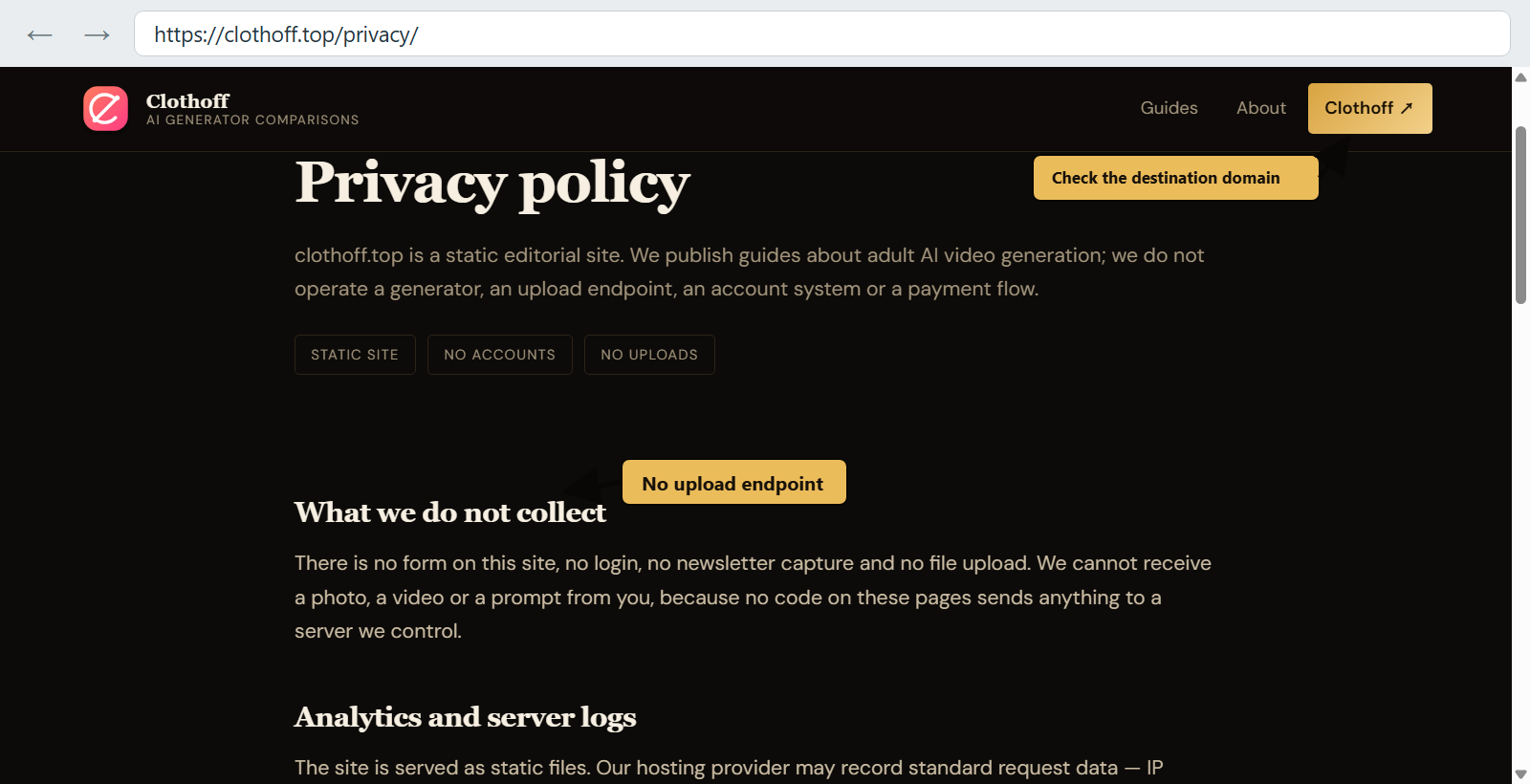
ClothOff’s first-party privacy page says the editorial site cannot receive photos, videos, or prompts; any linked destination therefore requires its own privacy review.
The final go/no-go record
Immediately before any upload, create a dated record containing:
- Source owner, licence, and permitted transformation
- Identifiable adults and the scope of their consent
- Adult-status confirmation method, with unnecessary identity data excluded
- Exact receiving domain and legal operator
- Privacy-policy and terms URLs with access dates
- Training, improvement, moderation, and third-party-processing answers
- Retention periods for sources, outputs, logs, moderation copies, and backups
- Metadata inspection result and sanitized working filename
- Deletion routes for files, projects, outputs, and accounts
- Intended audience and sharing boundary
- Final decision and the person responsible for it
Proceed only when every material answer is specific enough to save. Stop when identity or adult status is unresolved, rights are ambiguous, consent does not cover the intended transformation, retention remains unclear, or no credible deletion path can be found.
ClothOff can help frame the evaluation, but its editorial pages are not the upload service. The decisive privacy review belongs at the exact destination that will receive the file.